The Class Selection
Matching Frame to Mission
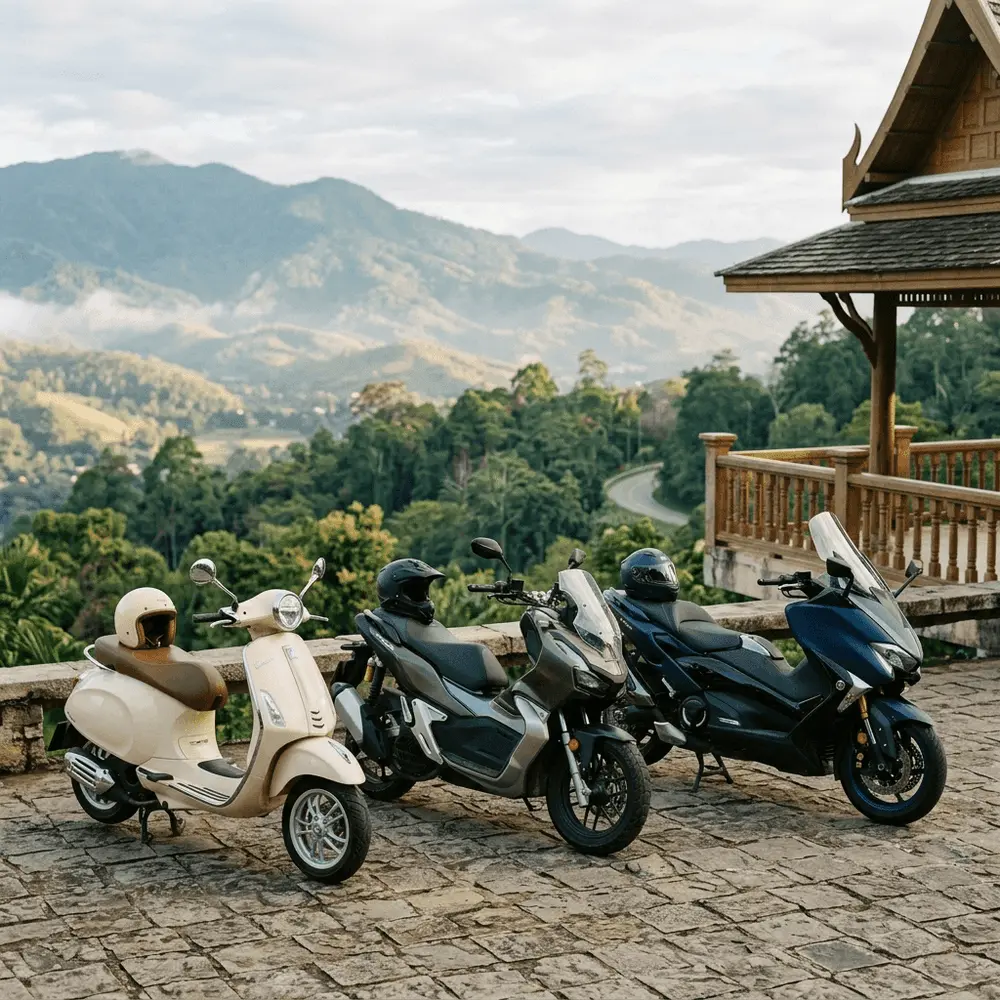
Decoding the Three Pillars
When you walk into a rental shop in Chiang Mai, you are confronted with a row of bikes that look similar to the untrained eye. However, in Northern Thailand, these bikes are categorized into three distinct “Missions.” Choosing the wrong one isn’t just about comfort—it’s about the mechanical limits of the machine.
In this guide, we break down the City Class, the Adventure Class, and the Touring Class to help you match your bike to your intended route. What travelers don’t realize is that Chiang Mai isn’t just “rolling hills.” The gradient from the base of Doi Suthep to the temple is consistently 10-12%.
Frame and Physics Comparison
The fundamental differences between these classes lie in their safety technologies, payload capacities, and wheel geometry.
| FEATURE | City (110-125cc) | Adventure (150-160cc) | Touring (300cc+) |
|---|---|---|---|
| Ideal Load | Solo (under 90kg) | Two-Up (under 160kg) | Two-Up + Luggage |
| Brake Tech | Disc/Drum (No ABS) | Dual Disc + ABS | Dual Disc + ABS + TCS |
| Wheel Size | 12” - 14” | 14” - 15” | 15” - 16” |
| Storage | 1 Small Helmet | 1 Full-Face Helmet | 2 Full-Face Helmets |
The Three Pillars
110cc - 125cc
1. The City Class
Examples: Honda Click 125, Scoopy, Fazzio.
The Mission: Nimman café hopping, Old City temple tours, and getting to your coworking space.
Why Choose It: Lowest cost (150-250 THB/day), easiest to park in tight gridlock, and excellent fuel economy.
The Limit: These bikes use small brakes and most lack ABS. Pushing them up mountains with a passenger causes rapid brake fade.
150cc - 160cc
2. The Adventure Class
Examples: Honda ADV 160, Yamaha NMAX.
The Mission: The Samoeng Loop, Doi Suthep, and day trips to waterfalls within a 50km radius.
Why Choose It: Safety. Dual-Channel ABS and 14/15-inch wheels. The 160cc engine has the torque to carry two people up a mountain without screaming.
The Limit: Slightly harder to park on busy Nimman sidewalks due to wider fairings and heavier weight.
300cc+
3. The Touring Class
Examples: Honda Forza 350, ADV 350.
The Mission: The Mae Hong Son Loop (600km+), trips to Pai, or any ride involving 4+ hours in the saddle.
Why Choose It: Comfort and Passing Power. At highway speeds (80-100 kph), a 350cc bike is barely breaking a sweat and can overtake trucks safely.
The Limit: Heavy (180kg+). Beginners will struggle with the low-speed weight. Significant rental cost (600-900 THB/day).
Don’t bring a knife to a gunfight. Choosing a 110cc Scoopy for a two-up ride to Pai is a high-risk choice for most casual travelers in the North. Match the frame to the mission.
Which one for you?
”I just want to get to my hostel…”
…and maybe the night market or a café in Nimman. You aren’t leaving the city grid.
”I want to see the temple…”
…and maybe do a mountain loop to Samoeng. You value safety and stopping power on steep gradients.
”I’m heading to Pai…”
…and staying for a week. You want highway comfort, wind protection, and massive under-seat storage.
"Specs help, but condition matters more. Before you head to the hills, check the tires, squeeze the brakes, and make sure the bike feels manageable at a stop. Safety in Chiang Mai isn't found in a brochure."
By Kai Mercer · Updated April 26, 2026